
Working Together

Bransholme Surgery
Bransholme Health Centre
Goodhart Road
Hull
HU7 4DW
Southcoates Surgery
225 Newbridge Road
HULL
HU9 2LR
Field View Surgery
840 Beverley Road
Hull
HU6 7HP
The Orchard Centre
210 Orchard Road
HULL
HU6 9BX
Elliott Chappell Health Centre
215 Hessle Road
HULL
HU3 4BB
The Quays
2nd Floor
Wilberforce Health Centre
6-10 Story Street
HULL
HU1 3SA
Riverside Medical Centre
The Octagon
Walker Street
HULL
HU3 2RA
East Park Practice
2nd Floor
Wilberforce Health Centre
6-10 Story Street
HULL
HU1 3SA
A vaginal pessary is a removable support device that is inserted into the vagina to function as a supportive structure to keep in place the uterus (womb), and/ or bladder, and/or the rectum, or the vaginal vault (if you have had a hysterectomy).
Your uterus, bladder or rectum has dropped down into your vagina because your pelvic floor muscles are weak, and/or the vaginal elastic supports have been damaged, childbirth, aging, and or normal ‘wear and tear’, and are not providing enough support. This is called a pelvic organ prolapse.
Prolapse can be caused by things such as:
If you experience any of the following you must report these to your nurse/doctor:
Your doctor/nurse will decide which type of pessary you should use depending on the type of prolapse you have, previous surgeries you have had and if you are sexually active. Usually, the first pessary that is inserted fits comfortably. If it falls out, please contact your doctor/nurse and another will be refitted. Sometimes the size or shape of the pessary may need to be altered. Depending on the type of pessary fitted you may/may not be able to be sexually active. Please discuss this with your nurse/doctor.
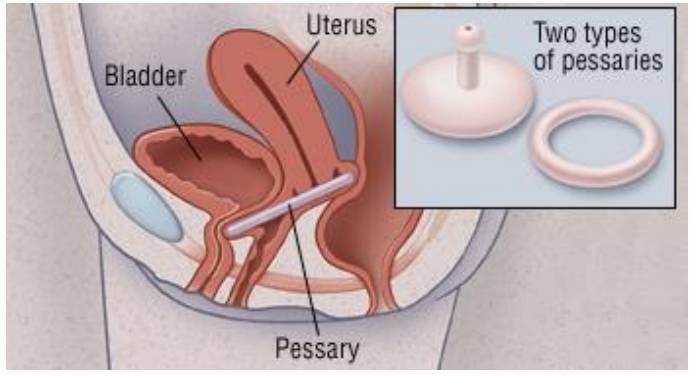
Once the pessary has been fitted, it will need to be changed every 4-6months. The nurse/doctor will ask you if you have had any problems with bleeding, discharge, urinary problems, bowel problems or discomfort. The pessary will then be gently removed, and the nurse/doctor will examine the vaginal walls for any infection or ulcerated areas. If there are no abnormalities a new pessary will be inserted.
Patients must be assessed by a clinician within their own practice and diagnosed with vaginal prolapse or have already been assessed and diagnosed by Gynaecology.
For patients currently attending hospital for pessary changes, these can now be offered locally.
Please discuss with your GP practice.
| DAY | LOCATION |
|---|---|
| Tuesday | Orchard Health Centre, Bridge Group Practice |